The SEO landscape looks very different from what it did even two years ago. Google’s AI Overviews now sit above traditional search results for a growing number of queries. AI-powered answer engines like ChatGPT, Perplexity, and Claude are pulling traffic away from conventional search entirely. And a new discipline called Answer Engine Optimization (AEO) has emerged alongside traditional SEO as something every serious website owner needs to understand.
With all of that happening, it is fair to ask whether link building still deserves a place in your strategy. The short answer is yes. But the way it works, the way it earns results, and the way it fits into a broader digital strategy have all shifted in ways that matter.
The Role of Links Has Evolved, Not Disappeared
Links remain one of the strongest signals that search engines use to assess the authority and trustworthiness of a website. That has not changed. What has changed is how that authority gets used.
Google’s AI Overviews pull information from pages that already demonstrate strong authority signals. An Ahrefs study found that over 76 percent of pages cited in AI Overviews also rank in Google’s top 10 organic results. That means backlinks are not just helping you rank in traditional search — they are also influencing whether your content gets selected as a source in AI-generated answers.
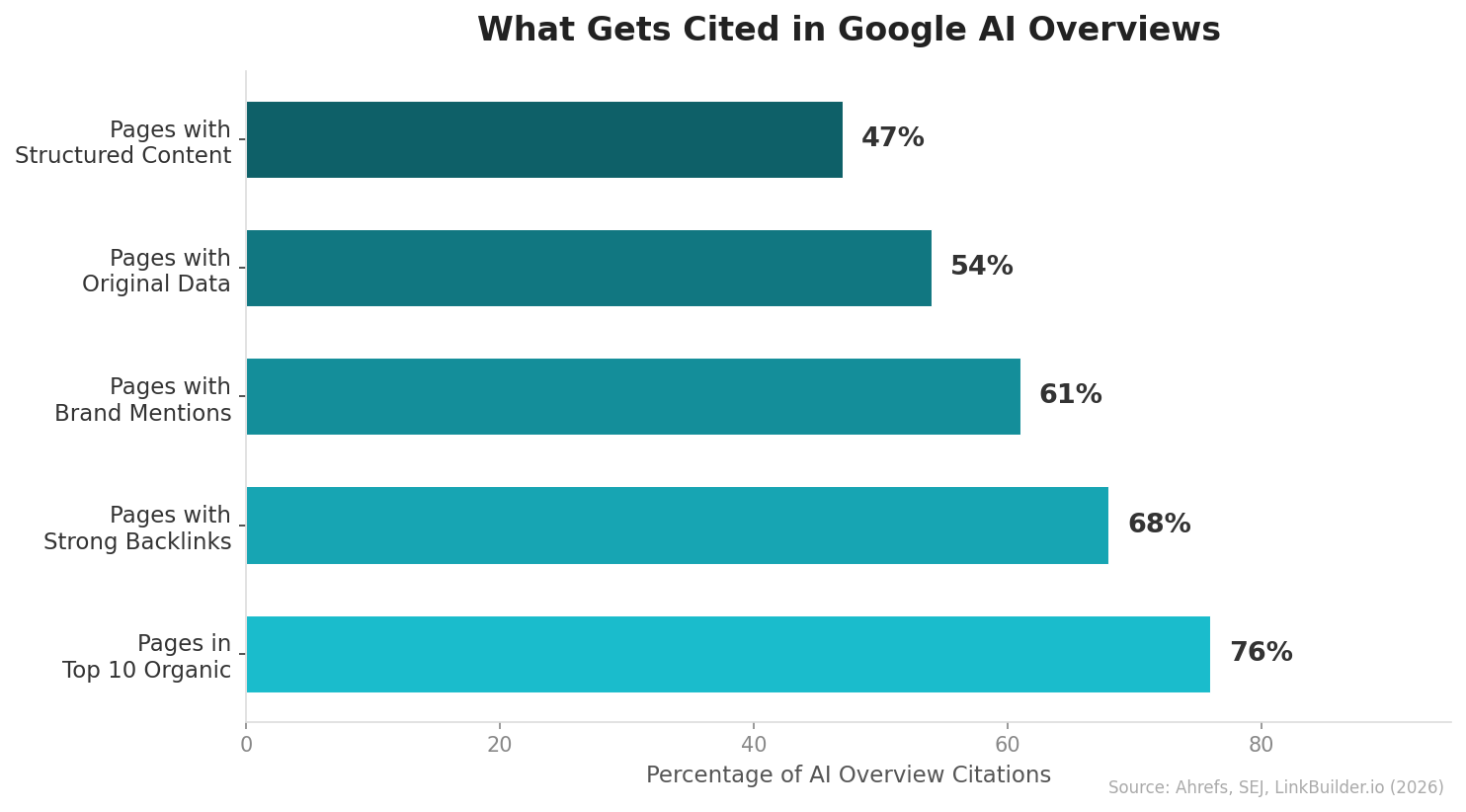
The same principle applies to other AI platforms. When ChatGPT, Perplexity, or Claude generate responses and cite sources, they tend to reference pages with established authority. The sites earning those citations are the ones with strong backlink profiles, consistent brand mentions, and content that has been validated by other reputable sources across the web.
Links are no longer just about ranking. They are about being recognised as a trustworthy source across an entire ecosystem of search and AI platforms.
What Is Answer Engine Optimization (AEO)?
AEO is the practice of structuring your content so that AI-powered platforms can easily retrieve, understand, and cite it when generating answers. While traditional SEO focuses on ranking in search engine results pages, AEO focuses on getting your content selected as a source by AI systems that generate direct answers to user queries.
The two disciplines are not in competition. The best-performing content in 2026 typically does both — answering questions directly and concisely while also providing the depth and supporting detail that human readers expect.
For link building, AEO introduces a new dimension of value. When AI systems decide which sources to cite, they evaluate authority signals that include backlinks, brand mentions, and the overall credibility of the domain. This means the links you build are now serving two purposes: improving your rankings in traditional search and increasing the likelihood that AI engines will reference your content as a source.
How Google AI Overviews Changed the Game
Before AI Overviews, the goal was straightforward: rank as high as possible in the organic results. Now, there is a layer above those results that captures a significant share of user attention and clicks. Studies show that AI Overviews have reduced click-through rates by as much as 61 percent for certain types of queries.
That sounds alarming, but it actually reinforces the importance of authority-building through links. The pages that get cited within AI Overviews are overwhelmingly the ones that already have strong SEO fundamentals, including robust backlink profiles. If your site is authoritative enough to be cited in an AI Overview, you gain visibility even when users do not click through to the traditional search results.
The takeaway is not that link building is less important. It is that link building now needs to aim higher. Building authority that gets you into the top 10 organic results is no longer enough. You want authority that gets you cited as a source at the very top of the page, inside the AI-generated answer itself.
The Old Playbook No Longer Works
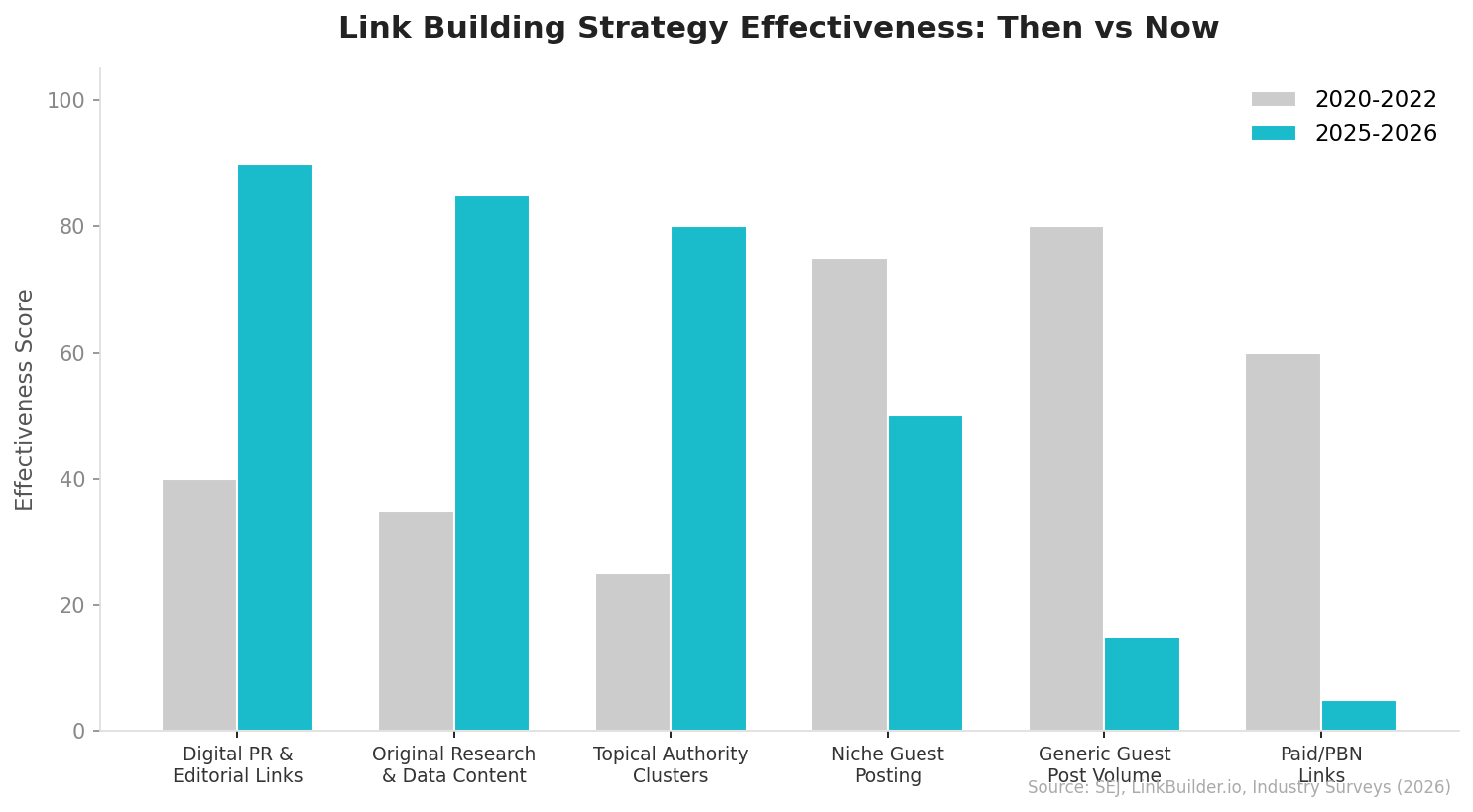
If your link-building strategy still revolves around chasing guest posts on low-relevance blogs, buying links based on Domain Rating alone, or pursuing raw volume over quality, you are operating on an outdated model. The tactics that moved the needle five years ago are either ineffective or actively harmful in the current environment.
Google has become significantly better at identifying artificial link patterns. The emphasis on helpful content and genuine expertise means that links from irrelevant or low-quality sources carry less weight than ever. In some cases, they carry negative weight.
The shift is clear: fewer, stronger, more relevant links outperform a high volume of weak ones. Quality has always mattered in theory. In 2026, it matters in practice more than it ever has.
Link-Building Strategies That Actually Work in 2026
Digital PR and Editorial Coverage
Digital PR has emerged as one of the most effective link-building strategies because it earns editorial links from high-authority news and media sites while building genuine brand awareness. When a reputable publication covers your business, links to your site, and mentions your brand, it sends exactly the kind of signal that both search engines and AI systems value.
This requires having something worth covering — original research, unique data, a compelling story, or genuine expertise in a topic that journalists and editors care about.
Original Research and Data-Driven Content
Publishing original research, surveys, case studies, and data analyses positions your brand as a primary source. Other websites link to primary sources because they add credibility to their own content. This kind of content earns links naturally over time and is particularly effective for AEO, because AI systems prioritise original data when generating answers.
If you can produce a statistic, a benchmark, or an insight that does not exist elsewhere, other sites will reference it. That is the most durable form of link building available.
Building Topical Authority Through Content Clusters
Rather than building links to isolated pages, the most effective approach is to build topical authority across an entire subject area. This means creating comprehensive content clusters around your core topics and earning links to multiple pages within those clusters.
Search engines and AI platforms both favour sources that demonstrate deep, consistent expertise in a defined area. A site with 30 well-linked articles on a single topic will outperform a site with 300 thinly-linked articles on 300 different topics.
Brand Mentions and Entity Building
Not every valuable reference comes with a hyperlink. Brand mentions without links still contribute to how search engines and AI systems understand your authority. Google’s systems have become increasingly sophisticated at connecting brand mentions to specific entities, even without a direct link.
Actively building your brand’s visibility through industry participation, expert commentary, podcast appearances, and contributions to relevant communities creates a web of recognition that supports your link-building efforts.
Strategic Internal Linking
External links get the most attention, but internal linking is one of the most underused tools in any site’s SEO toolkit. A strong internal linking structure helps search engines understand the relationships between your content, distributes link equity across your site, and guides users to your most important pages.
When you earn a strong external link to one page, internal links allow that authority to flow through to related pages. Without a thoughtful internal linking strategy, much of the value from your external links gets wasted on pages that do not need it.
Manual Link Building vs. Paid Links in 2026
The temptation to take shortcuts with paid links persists, but the risks have only increased. Google’s systems for detecting unnatural link patterns are more sophisticated than ever. Paid links that violate Google’s guidelines can result in penalties that are difficult and time-consuming to recover from.
Manual link building — earning links through outreach, relationship building, and the creation of genuinely valuable content — remains the sustainable approach. It takes more effort. It takes more time. But the links it produces are more durable, more valuable, and far less likely to cause problems down the line.
The distinction is straightforward: paid links are a transaction, manual links are an investment. Transactions depreciate. Investments compound.
How to Audit Your Current Backlink Profile
Before building new links, it is worth understanding what you already have. A backlink audit helps you identify which links are helping, which are neutral, and which might be hurting your site’s performance.
Start by exporting your backlink data from a tool like Ahrefs, Semrush, or Google Search Console. Look at the quality and relevance of your referring domains. Are they in your niche? Do they have genuine traffic? Are they sites that a real person would visit and trust?
Flag any links that look unnatural — links from irrelevant directories, link farms, foreign-language spam sites, or pages that exist solely to host outbound links. If you find a significant number of toxic links, Google’s disavow tool can help you distance your site from them.
The audit also reveals gaps. If your competitors have strong links from industry publications, news sites, or academic resources that you lack, those gaps become your roadmap for future link-building efforts.
The Link Building Funnel for 2026
The most effective link-building programs in 2026 follow a structured funnel that starts with content creation and ends with compounding authority across both traditional search and AI platforms.
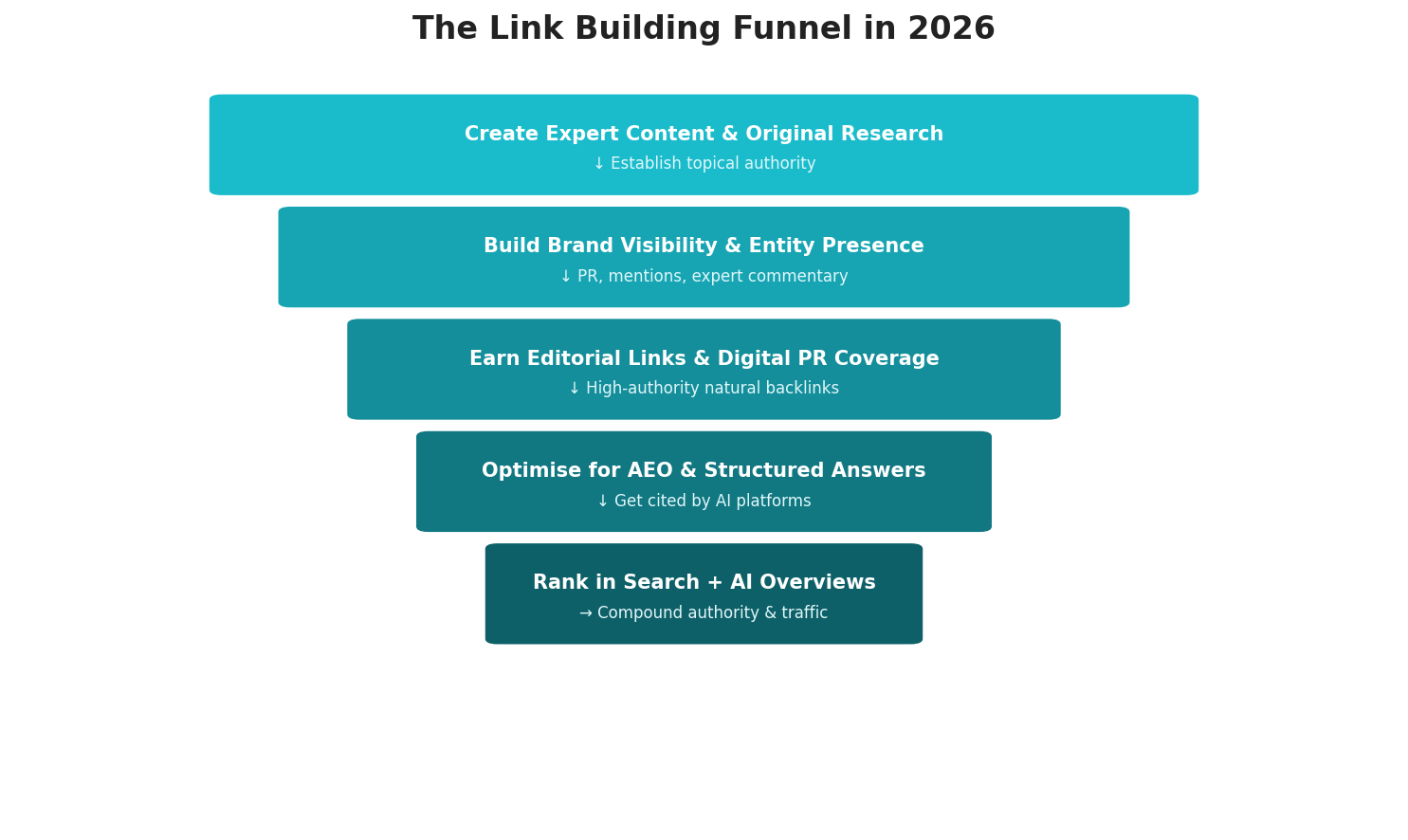
Each stage feeds the next. Expert content attracts brand visibility. Brand visibility leads to editorial coverage and natural links. Those links improve your authority signals for both search rankings and AI citations. Over time, the effect compounds — stronger authority leads to more citations, which leads to more links, which strengthens authority further.
Where This Is All Heading
The direction of search is toward systems that understand quality, authority, and relevance at a much deeper level than simple link counts. AI is accelerating that shift. The websites that will perform best over the coming years are the ones building genuine authority through expert content, earned media coverage, and organic brand recognition.
Link building is not going anywhere. But the version of link building that works in 2026 looks very different from the version that worked in 2020. It requires better content, more strategic thinking, and a willingness to invest in approaches that build real authority rather than artificial signals.
The fundamentals have not changed. Earn links from sources that matter by creating content worth linking to. The tools and tactics evolve, but that principle remains as relevant as it has ever been.